

Security for Warehouses in Chicago: Systems, Risks, and Compliance
What security for warehouses requires in Chicago: cameras, access control, verified alarm response, and Illinois compliance. Get a free assessment.
- Why Chicago Warehouses Face a Different Threat Profile
- Core Physical and Perimeter Measures
- Video Surveillance Systems for Warehouses
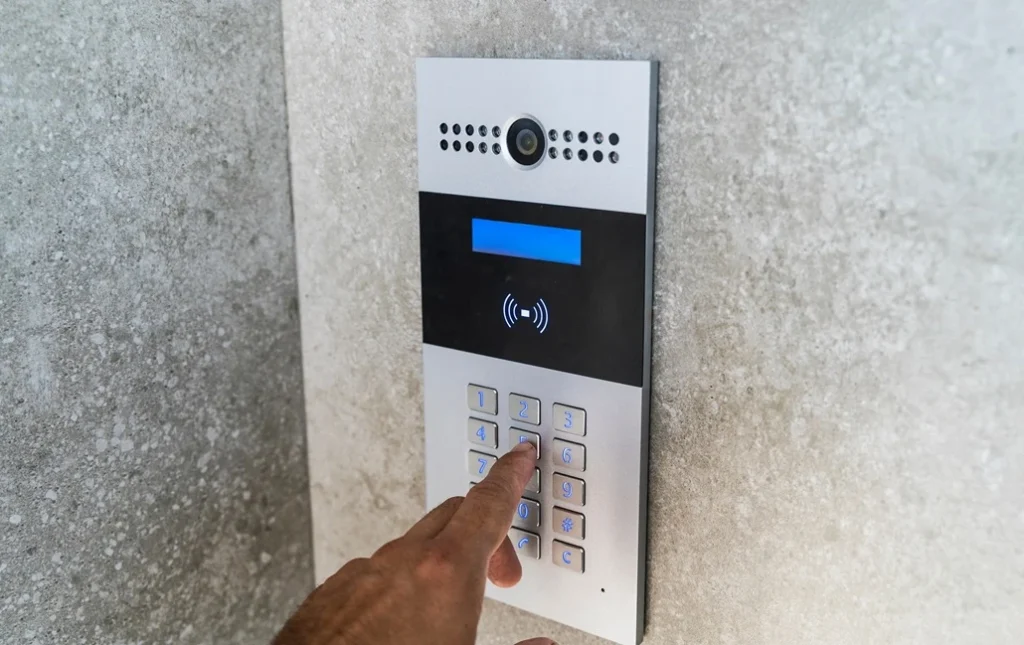
- Access Control Systems
- Get an Access Control System Designed Around Your Warehouse's Risk Profile
- Intrusion Detection and Alarm Response
- Inventory Control, Vendor Risk, and Insurance Exposure
- Cybersecurity and System Integration
- What Drives the Cost of a Warehouse Security System
- A Real Warehouse Security Project in the Chicago Region
- The Right Warehouse Security Setup for Each Risk
- What to Do Next
A warehouse in Chicagoland sits inside one of the busiest freight corridors in North America, and that changes what "security for warehouses" actually means here. The short answer: a working warehouse security system combines perimeter and yard protection, video surveillance with real-time monitoring, access control at every entry point, an intrusion detection system with verified alarm response, and a plan for how these pieces talk to each other. None of these on its own closes the gap. The rest of this guide walks through each layer, what it costs to build, and what Illinois and Chicago rules mean for the equipment you choose.
Why Chicago Warehouses Face a Different Threat Profile
Six of North America's seven Class I railroads intersect in the Chicago region, alongside Interstates 55, 80, 90, and 294. That concentration of intermodal yards, air freight terminals, and distribution space matters because national cargo theft is worsening fast: losses reached an estimated $725 million in 2025, a 60 percent increase over 2024, and the average value of a single stolen load climbed to $273,990, according to Verisk's CargoNet cargo theft analysis. Illinois is not the top state by incident count; California, Texas, and Tennessee lead that list, according to FreightWaves' 2025 cargo-theft breakdown, but the volume of trailers staged, switched, and transferred through the region every day concentrates the exposure at specific points: drop lots, rail-to-truck transfer yards, and gate checkpoints, rather than spreading it evenly across a warehouse's four walls.
That risk is not spread evenly across the region. It clusters around three distinct submarkets, and the right security setup looks different in each one.
Important: A single documented case shows the scale of exposure at these corridor facilities. A trailer of Target merchandise was stolen from a Joliet facility in December 2025; the Cook County Sheriff's Organized Retail Crime Unit later recovered it in Oak Forest, along with more than $2 million in related stolen goods, according to the Chicago Sun-Times. That is the kind of loss a static fence line and an unmonitored camera feed will not stop.
Core Physical and Perimeter Measures
Before any camera or access reader goes in, the physical layer has to hold up on its own. For a warehouse, that means:
- Perimeter fencing and controlled gates at every vehicle entrance, not just the main one.
- Lighting across trailer yards and loading docks, since most break-ins and part theft happen after dark or during low-traffic shift changes.
- Kingpin locks on staged trailers left in drop lots. Cargo insurers increasingly treat this as a baseline requirement, not an option, for coverage on unattended trailers.
- Reinforced doors and windows at every ground-level entry, including secondary doors staff prop open for airflow or convenience.
- Restricted, separately locked storage for high-value inventory, rather than treating the whole floor as one security zone.
Tip: Walk your yard the way a driver would. If a trailer can be hooked and pulled without anyone at a gate confirming who is driving, that gap matters more than any camera pointed at the front door.
Video Surveillance Systems for Warehouses
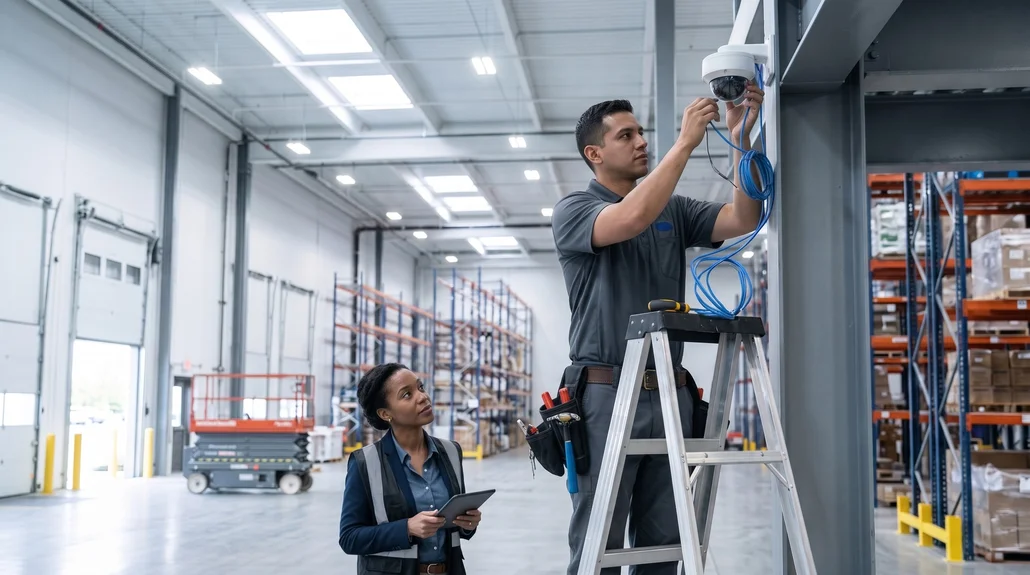
Cameras on a warehouse do two different jobs: they record what happened, and increasingly, they help verify what is happening right now.
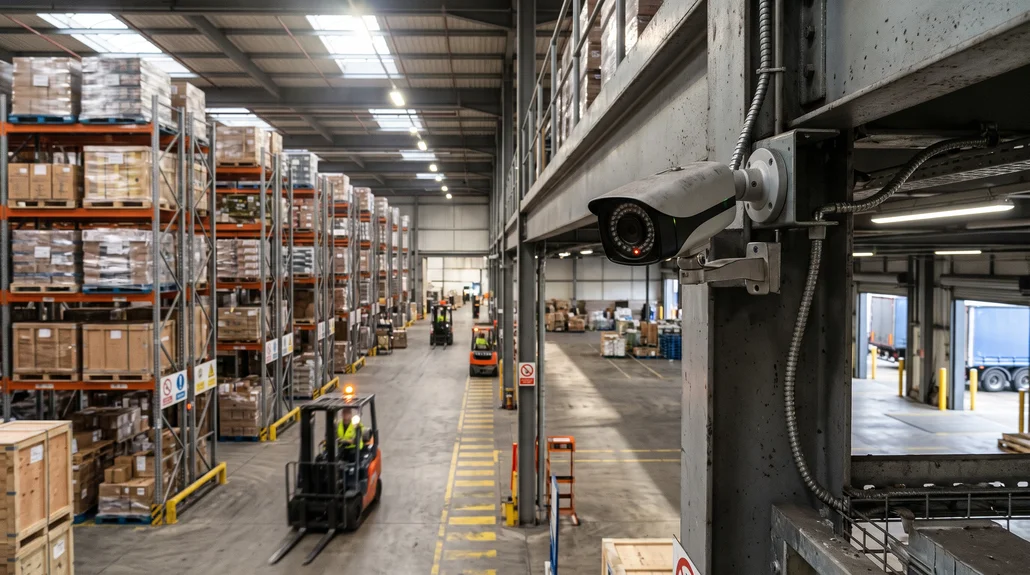
Camera Coverage for Warehouse Environments
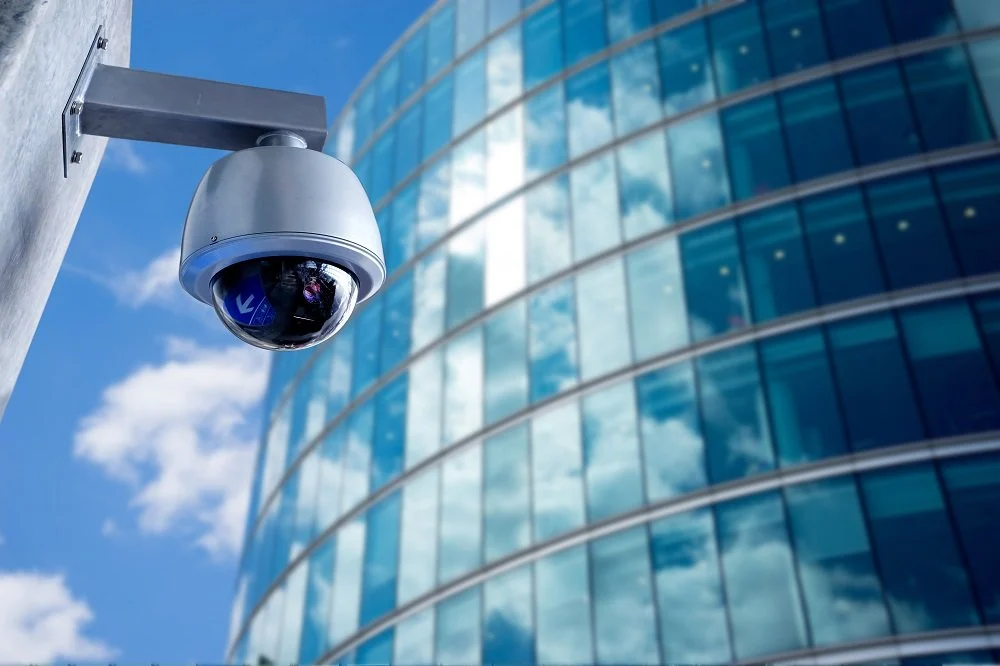
Interior cameras should cover high-value storage, loading dock interiors, and employee entrances. Exterior coverage needs to reach the full yard, not just the building face, since drop-and-hook staging areas and parked trailers are where a large share of loss actually occurs.
Gate Verification Technology
Automated license plate recognition and optical character recognition for container numbers let a system cross-check the tractor and trailer actually at the gate against what a driver's paperwork claims. This directly addresses a documented pattern in Chicago-area freight theft: drivers presenting a valid-looking bill of lading for a load they were never authorized to pick up. A gate that only checks paperwork by asking "who do you work for" is not verifying anything; a camera system tied to plate recognition and a driver-authentication check is.
Our video surveillance systems are designed around this kind of layered coverage, from interior storage zones to yard-wide exterior monitoring, rather than a single generic camera package.
Access Control Systems
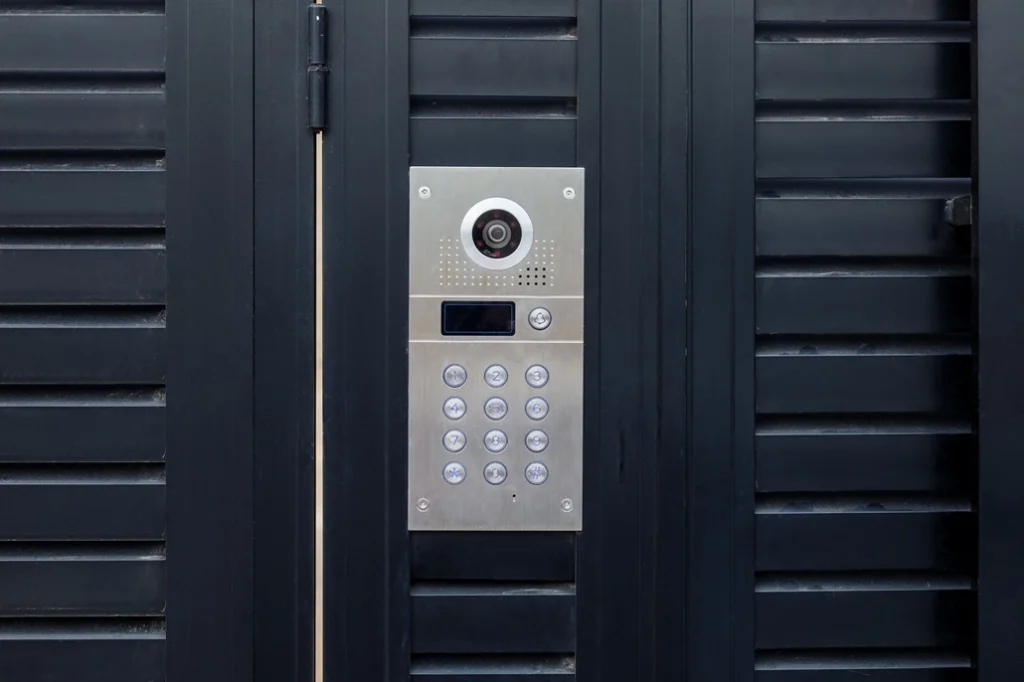
Access control decides who gets through a door, but on a warehouse the more useful question is who gets through which door, and when.
Important: Illinois' Biometric Information Privacy Act (740 ILCS 14/15) requires written notice and consent before collecting fingerprint or facial-recognition data, and sets statutory damages of $1,000 per negligent violation and $5,000 per intentional violation. This is not a theoretical risk for logistics facilities: in June 2026, a federal court granted class-action status in a case against Universal Intermodal Services over fingerprint scanners used to clock in contracted drivers and temporary staff at a Harvey, Illinois facility, according to FreightWaves' coverage of the case. A warehouse that wants biometric access control for gate staff or drivers needs a documented consent and retention process in place before the hardware goes live, not after.
Zoned access, separating general warehouse floor access from restricted high-value storage, from office areas, and from contractor or visitor entry, closes a gap that a single all-access badge system leaves open by design.
#cta_start
Get an Access Control System Designed Around Your Warehouse's Risk Profile
Credential type, BIPA consent requirements, and zoned access decisions all have to be settled before the first card reader goes on a door. Forbel designs and installs access control systems for Chicago-area warehouses and distribution facilities, matching credential type to each entry point and building the documented consent process biometric readers require under Illinois law before any hardware goes live.
#cta_end
Intrusion Detection and Alarm Response
An alarm system is only as useful as the response behind it, and in Chicago, that response is shaped directly by city policy.
Self-Monitored vs. Professionally Monitored Alarms
A self-monitored system sends a push notification to whoever is on the distribution list, and it is that person's judgment call whether to act on it. A professionally monitored system routes the same trigger to a monitoring center that can confirm activity on camera and report it to police as an active event rather than an automated trip.
Why Verified Response Matters in Chicago
Chicago enforces Municipal Code Section 8-4-056: every unverified commercial burglar alarm draws an automatic $100 fine, with no courtesy warning on the first offense. Beyond the fine, dispatchers prioritize calls carrying some form of verification over an automated alarm trip with no confirmation behind it, so an unverified alarm is competing for attention against calls that already have confirmed activity.
A video-verified alarm changes the sequence: a monitoring operator who visually confirms a person on-site after hours can report an active intrusion, not a routine alarm activation, which is what actually earns a faster, prioritized police response.
Our intrusion detection systems are built around this distinction, pairing alarm hardware with the kind of verification that keeps a warehouse off the false-alarm fine list and closer to the front of the dispatch queue when something real is happening.
Inventory Control, Vendor Risk, and Insurance Exposure
Case: an unattended trailer sitting in a drop lot without a kingpin lock or active monitoring is often exactly the scenario cargo insurers write out of coverage. Many Motor Truck Cargo policies now carry an "unattended vehicle" or "secure yard" warranty, and if a loaded trailer is stolen from a yard that does not meet that warranty's conditions, the underwriter can deny the claim outright, regardless of the load's value.
That single fact changes how a facility should think about security spending. It is a condition of the insurance coverage the business already pays for, not just a loss-prevention line item. Beyond the yard, inventory-level controls matter too:
- RFID or barcode tracking tied to what actually enters and leaves the building, not just what the warehouse management system assumes happened.
- Documented visitor and contractor check-in, since tailgating through a propped dock door is one of the most common ways an unauthorized person ends up on the floor.
- A single point of contact responsible for reconciling gate logs against shipment records, rather than leaving that check to whoever happens to be at the dock that shift.
Cybersecurity and System Integration

Modern warehouse security runs on network-connected hardware: IP cameras, cloud-managed access control, and alarm panels that report to a monitoring center over the internet. Many facilities also carry a mix of legacy analog cameras, standalone card readers from a previous tenant, and an alarm panel installed years apart from everything else, none of it talking to the others.
That fragmentation creates blind spots of its own: gate staff without real-time data to check a driver against, video that takes hours to pull during an actual investigation, and no single dashboard showing whether every door and camera is actually online. Consolidating these systems under one platform, with basic network hygiene like changed default passwords and restricted remote access, closes gaps that no individual camera or lock can fix on its own.
What Drives the Cost of a Warehouse Security System
There is no flat price for a warehouse security system, because the real cost depends on a specific set of variables at your site, not a single equipment category:
- The number of vehicle and pedestrian entry points that need controlled access.
- Whether existing wiring and cameras can be reused or need replacement.
- Yard size and how much exterior coverage the perimeter actually requires.
- Whether the alarm system includes professional, video-verified monitoring.
- Integration work needed to bring legacy hardware onto one platform.
Because these variables shift so much between a single-building 100,000-square-foot facility and a multi-tenant distribution campus, a site assessment is the only way to turn this list into an actual number for your building.
A Real Warehouse Security Project in the Chicago Region
For a 250,000-square-foot cold storage facility expansion in Wilmington, Illinois, in the same I-55 corridor as the freight hubs described above, Forbel installed a smart card access control system for the parking lot and more than 60 HD IP cameras across the warehouse interior. The interior cameras had to solve two site-specific problems: uneven, low-light conditions typical of a cold storage building, and a ghosting effect on camera footage caused by constant forklift movement. Forbel specified cameras with low-light performance, dynamic range, and anti-ghosting capability to address those two conditions directly, rather than installing a standard camera package and hoping it held up. See the full project.
The Right Warehouse Security Setup for Each Risk
Match the measure to the threat it actually addresses, rather than starting from a list of products.
For a facility already operating in the logistics and distribution space, the starting point is usually less about picking a product category and more about identifying which of these five risks the current setup actually leaves open.
What to Do Next
A warehouse security system is not one purchase, it is a set of layers that each close a specific gap: physical barriers at the perimeter, cameras and access control at every entry, an alarm system built for verified response, and a plan for keeping all of it on one platform instead of four disconnected ones. The Chicago-specific pieces, from Municipal Code 8-4-056 to Illinois' biometric privacy law, are not fine print. They shape which equipment makes sense for your building and how fast a real incident actually gets a police response.
Forbel Alarms has designed, installed, and integrated commercial security systems for warehouses and distribution facilities across Chicago and the surrounding region for more than a decade. If you want a clear picture of where your current setup has gaps, schedule a site assessment built around how your warehouse actually operates, not a generic package.

Heading
Frequently Asked Questions
Does Chicago fine businesses for false burglar alarms?
Yes. Under Municipal Code Section 8-4-056, an unverified commercial burglar alarm draws an automatic $100 fine with no courtesy warning on the first offense. Video-verified alarm monitoring is the most direct way to avoid triggering this fine from environmental false alarms.
What is verified alarm response, and why does it matter for a warehouse?
Verified response means a monitoring operator confirms activity on camera or audio before reporting an event to police as an active incident, rather than an automated alarm trip. In Chicago, verified events are prioritized over unverified ones, and a video-verified report gives dispatch and responding officers confirmed information an automated alarm signal cannot provide on its own.
Is biometric access control legal for warehouses in Illinois?
It can be, but the Illinois Biometric Information Privacy Act requires written notice and consent before collecting fingerprint or facial-recognition data, along with a documented retention policy. Logistics facilities using fingerprint check-in for drivers or temporary staff have faced class-action exposure under this law, so the compliance process needs to be in place before the hardware is installed.
Can new security technology integrate with our existing cameras and access control?
In most cases, yes, provided the existing equipment is still supported by its manufacturer and can connect through an open standard or shared platform. A site assessment is the way to confirm what can be kept and what needs to be replaced.
Do I need a security guard, a security system, or both?
They are not competing options. Cameras, access control, alarms, and lighting cover the parts of a facility no guard can watch continuously, while trained personnel add judgment and physical presence where a system alone cannot act. Most Chicago-area warehouses end up combining both, with technology reducing how much a facility has to rely on guard consistency alone.