.svg)


SIP Intercom: What Is It & Why Your Business Needs One
Looking for a reliable access control solution? Discover how a SIP intercom system can enhance security and simplify entry management.

Who knew there were so many intercom options to choose from? While it may seem like an easy decision, selecting the right access control system for your business, apartment, or school is essential for smooth operations and reliable security. SIP and video intercom systems stand out among the plethora of options, combining IP-based communication with remote access via smartphones and strong security protocols.
The global SIP intercom market, valued at $206 million in 2024 and projected to reach $289 million by 2031, reflects growing adoption as businesses reduce installation costs by up to 70% compared to analog systems while gaining superior functionality and efficiency. So, is a SIP intercom system right for you? Let’s break it down.
What Is a SIP Intercom?
So, what is a SIP intercom? A SIP, or Session Initiation Protocol, the intercom is an electronic system that allows tenants to use the intercom to speak with someone looking to gain entry. With this system, a tenant or employee can grant someone access, buzzing them in without actually going to the door.
Like IP systems, a SIP doorbell intercom utilizes the internet to transmit data, reducing the need for wiring for a more efficient, easier-to-install system. Plus, with an access control system that relies on the internet, the need for a physical person to allow entry into space is eliminated, creating more ease and convenience when unlocking doors. This is beneficial to a number of locations — from apartments to offices, student housing, and more.

Components of a SIP Intercom System
When it comes to the elements of a SIP video intercom system, there are four parts to consider. Here’s the breakdown:
1. Base Station (Door Station)
The entry-point hardware, typically flush-mounted at building entrances, houses a microphone, a speaker, a camera module, and call button components. These stations initiate SIP sessions when visitors press to connect with residents or staff. Modern base stations feature conformal-coated electronics, protecting circuitry against weather exposure and vandalism.
2. SIP Server Infrastructure
This is a central hub that manages all communication sessions, handling call establishment, modification, and termination. The server maintains databases of authorized credentials and directs incoming calls to appropriate substations. Cloud-based SIP servers eliminate on-premises hardware requirements while enabling remote system management through HTTPS connections.
3. Substations (User Endpoints)
Substations represent devices that authorized personnel use to receive calls from base stations. These supervised SIP endpoints include desk phones, smartphone applications, or dedicated indoor monitors. Each user can register multiple devices, ensuring calls reach staff regardless of physical location.
4. Electric Door Strike Mechanism
The final component executes access decisions, containing relay outputs that trigger electromagnetic locks or electric strikes when authorized users grant entry. These relays integrate with existing access control infrastructure, supporting various locking mechanisms without needing proprietary hardware.
How Does a SIP Intercom Work?
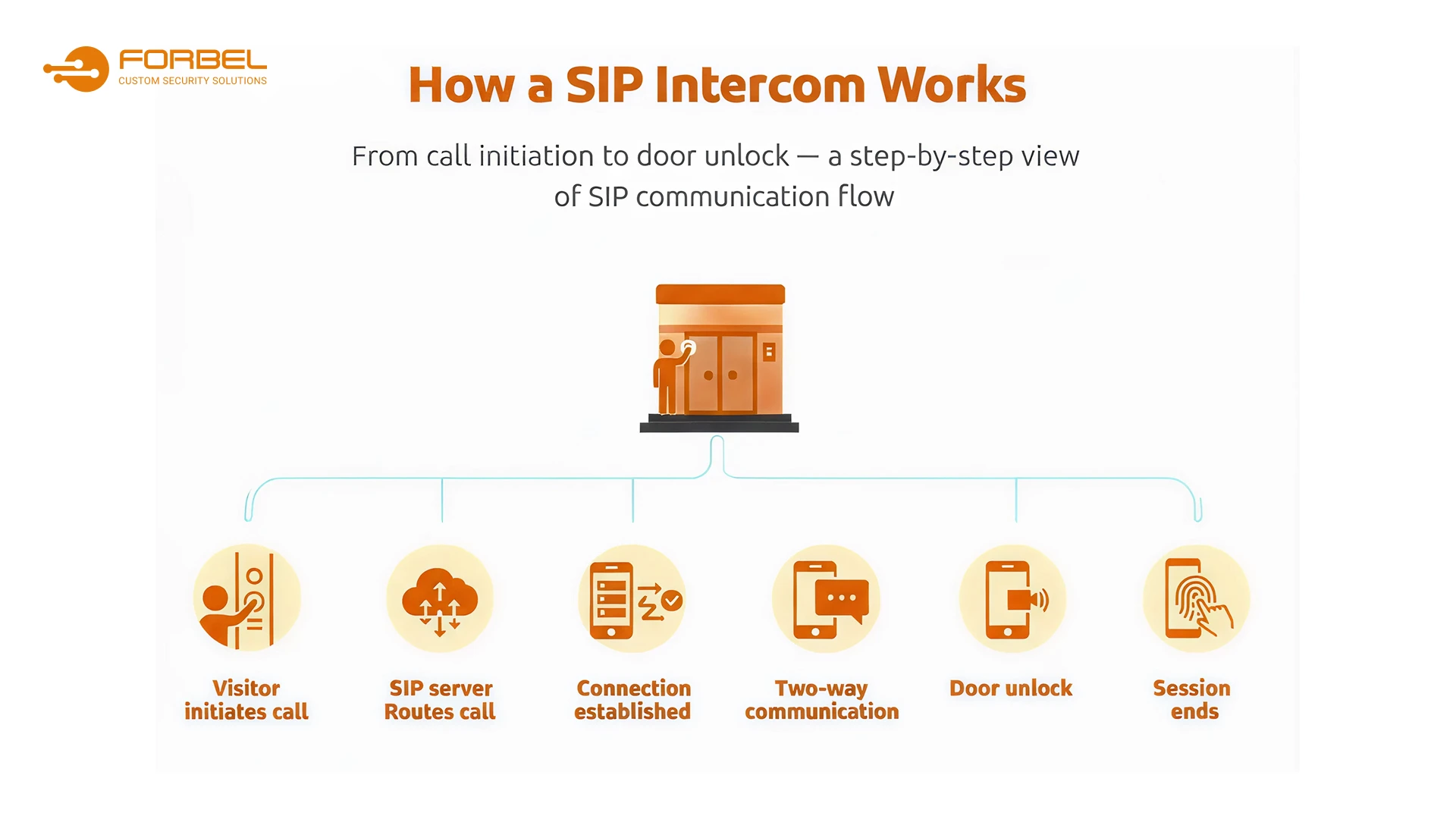
SIP intercoms use IP networking to convert voice and video into data packets sent over Ethernet. When a visitor presses the call button, a SIP INVITE request is sent to the server, which locates the recipient’s endpoint. Once answered, RTP (Real-Time Transport Protocol) streams carry audio and video, enabling two-way communication. The user can then trigger a relay to unlock the door, and the session ends with a SIP BYE message.
VoIP vs. SIP
VoIP refers to voice transmission over the internet, while SIP is the signaling protocol that manages call setup and termination. SIP intercoms rely on VoIP infrastructure but offer open-standard compatibility across manufacturers, avoiding vendor lock-in.
Network & Power
SIP systems run on standard IP networks using PoE (IEEE 802.3af/at) to supply both data and power through a single Ethernet cable, simplifying installation. Base stations connect via PoE network switches, and managed switches often use VLANs to keep intercom traffic secure and separate from other network data.
Why Commercial Buildings Require SIP Intercom Infrastructure
There are a whole host of benefits to incorporating a SIP intercom into your business’s security system, and we are here to explain each to help you make the best decision for your location.

Wireless Option
We are all about convenience, and with a wireless option for your SIP video door intercom, you get just that. In limiting the use of wires, you can guarantee a more seamless installation process that impacts the structure of your building less as there’s no need for intricate wiring to go into place.
Integration of SIP Intercom with Telephone Services
Talk about ease. A SIP intercom allows you to integrate your system with telephone services, allowing messages and communications from the door system to communicate with tenants’ and employees’ cell phones. This allows for more convenient answering and communication between stations.
Easy Management
Since multiple devices can be linked to this wireless system, a SIP intercom speaker allows for easy management of doors. With authorized personnel easily answering and allowing access, whether they are physically at the business or not, day-to-day communication, deliveries, and visitors can be managed with ease.
Broad Functionality
Since this is an internet-based system, SIP video intercom options have a heightened ability to store data. Not only can it store a great deal of data, but it does so at a super-fast speed, too. With virtual keys and passes, this system can support a number of options to make life easier and secure.
Leading SIP Intercom Manufacturers and Solutions
The commercial intercom market features multiple manufacturers with distinct capabilities and pricing structures.
Enterprise-Grade Providers
Axis Communications provides network intercom solutions with weatherproof construction, wide-angle cameras, and integrated access control readers. Their products support open standards for compatibility with hundreds of platforms.
2N Telecommunications manufactures IP Verso and IP Force product lines for commercial and industrial use. These modular systems accommodate various authentication readers and keypads, with IP68 weatherproofing, and can operate anywhere from -40°C to +60°C.
Grandstream Networks delivers the GDS series at price points 30-40% below premium manufacturers while maintaining video intercom capabilities, electromagnetic lock control, and mobile app integration.
Specialized Applications
Aiphone targets healthcare facilities, educational institutions, and assisted living environments with SIP-capable systems featuring specialized mounting options and failsafe operation.
Commend serves harsh industrial environments with explosion-proof enclosures, extreme temperature ratings, and redundant network connectivity for oil refineries, chemical plants, and transportation infrastructure.
System Cost Analysis and Budget Planning
Implementing a SIP intercom system involves upfront hardware, installation, and ongoing operational expenses. Base station units and network components vary by feature set, while cloud or on-premise server choices affect long-term costs. Overall, SIP intercom solutions offer scalable pricing that strikes the ideal balance between performance, flexibility, and total cost of ownership.
Selecting Optimal SIP Intercom Solutions for Your Property
When you match system capabilities to actual operational requirements, you prevent under-engineering and overspending on unnecessary features. Discover our team’s expert recommendations in the 5 Best Intercom Systems for Business.
By facility type:
- Offices: Prioritize visitor management, HD video for identity verification, and integration with reception systems.
- Multifamily: Ensure mobile access via smartphones and delivery features like time-limited entry codes.
- Industrial: Select rugged, noise-resistant units rated for harsh environments and hazardous zones.
- Schools: Choose systems with lockdown integration, visual alerts, and multi-point communication for emergencies.
Key features to evaluate:
- Video quality: From VGA to 4K, depending on security needs.
- Authentication: Options include RFID, keypads, or biometrics.
- Mobile access: Smartphone control for residents or remote staff.
- Integration: Compatibility with management, video, and access platforms.
- Environmental rating: IP65+ for outdoor durability.
Vendor criteria:
Opt for vendors offering reliable support, regular firmware updates, certified local installers, and open standards (SIP, ONVIF, HTTPS) to avoid vendor lock-in.
Interested in smart automation? Discover the next generation of security in our post on AI-Powered Video Intercoms.
Enhance Your Building's Access Control with Forbel
From increased security to convenient door entry, SIP intercoms are a wonderful addition to a range of buildings — from apartments to businesses, offices, and schools. This secure system, backed by the ever-evolving and improving internet, is built to last and evolve with you, storing data and updating it to suit your needs.
Whether you have more questions about SIP doorbell intercom options or are ready to install this system at your location, our experts at Forbel are here to help. To improve the security of your business’s access control, explore Forbel’s intercom solutions today.
.jpeg)
Get a Custom SIP Intercom Quote
We understand that every property has unique communication and access needs. Let our experts at Forbel create a tailored SIP intercom solution that fits your operational requirements and cost expectations.

Heading

Heading






Heading 1
Heading 2
Heading 3
Heading 4
Heading 5
Heading 6
Lorem ipsum dolor sit amet, consectetur adipiscing elit, sed do eiusmod tempor incididunt ut labore et dolore magna aliqua. Ut enim ad minim veniam, quis nostrud exercitation ullamco laboris nisi ut aliquip ex ea commodo consequat. Duis aute irure dolor in reprehenderit in voluptate velit esse cillum dolore eu fugiat nulla pariatur.
Block quote
Ordered list
- Item 1
- Item 2
- Item 3
Unordered list
- Item A
- Item B
- Item C
Bold text
Emphasis
Superscript
Subscript