.svg)


Fire Alarm Inspection & Testing Requirements Under NFPA Standards
Forbel Alarms explains fire alarm inspection requirements: what works for commercial properties, what to evaluate, and how to deploy it right. Read the guide.
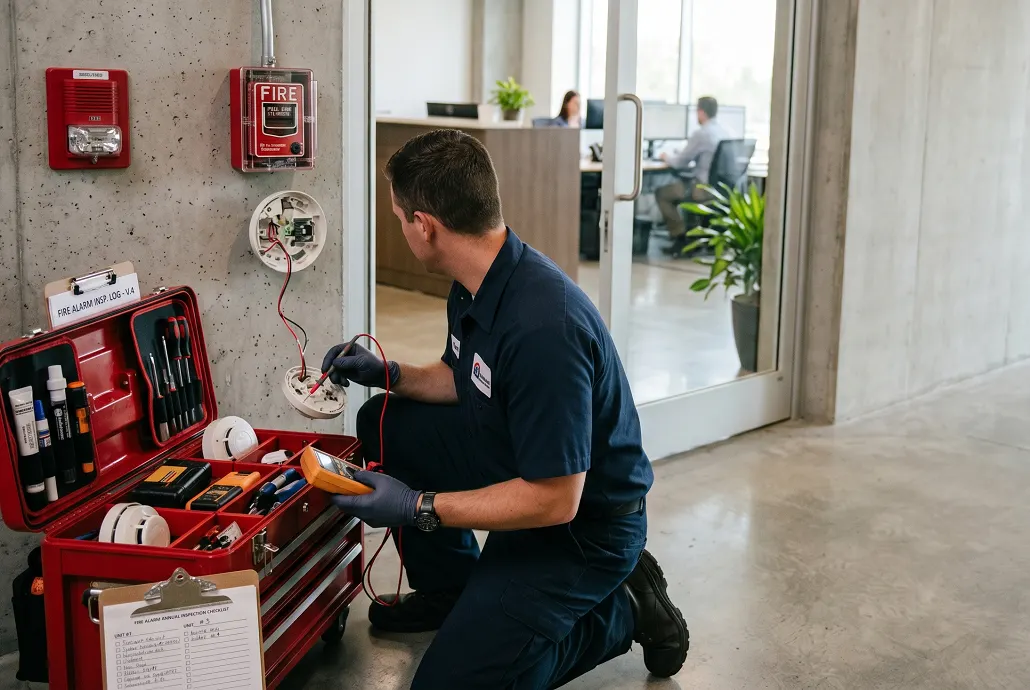
Commercial fire alarm systems must be inspected and tested on recurring schedules defined by NFPA 72 and the local Authority Having Jurisdiction (AHJ). Intervals vary by component, building type, and system age. This guide covers what gets inspected, how often, who qualifies to do it, and what records prove compliance.
Forbel Alarms works with commercial and multi-unit property teams across Chicagoland to keep commercial fire alarm systems inspection-ready year-round.
NFPA 72 Fire Alarm Inspection Requirements
NFPA 72 sets inspection, testing, and maintenance expectations for fire alarm systems across commercial, industrial, and multi-unit residential properties. The National Fire Protection Association publishes the standard, and local AHJs adopt it, sometimes with amendments that add obligations on top of the baseline. Facilities in Chicago, Elk Grove Village, and the broader Midwest should verify which edition their local code references.
Three terms carry distinct meanings under the standard:
- Inspection: A visual examination to confirm a device is in place, undamaged, and unobstructed.
- Testing: A functional verification that a device or system performs its intended operation under actual or simulated field conditions.
- Maintenance: Corrective or preventive action taken to keep the system in operating condition.
The NFPA 72 2025 edition provides updated safety provisions for fire detection, signaling, and emergency communications. Adopted editions differ by jurisdiction, so confirming which version applies to your property is the correct first step.
Compliance protects more than life safety. Insurers, property lenders, and municipal inspectors all require documented evidence that systems have been maintained. Failing to produce those records can result in fines, failed occupancy reviews, or denied insurance claims.
Fire Alarm Inspection Schedule by Device
NFPA 72 Chapter 14 defines the inspection and testing frequency for each system component. The intervals below reflect standard requirements. Your AHJ or system configuration may require more frequent attention.
Smoke and Heat Detectors
Smoke detectors require sensitivity testing to confirm each unit responds within its listed sensitivity range. Detectors that have drifted out of range — either too sensitive or not sensitive enough — are flagged for calibration or replacement. For placement rules and device-specific obligations, see commercial smoke alarm requirements.
Heat detectors undergo separate annual testing that verifies thermal elements activate at the correct threshold. Both device types must be documented at each cycle.
Control Panels, Batteries, and Wiring
Visual inspection of control equipment and power supplies is required on a quarterly to semiannual basis per NFPA 72 Chapter 14. Batteries that pass a visual check may still fail under load conditions, which is why functional testing is a separate requirement.
Older buildings and retrofit installations often carry undocumented wiring changes and component substitutions. For those properties, a baseline audit before the annual inspection cycle — which for many facilities aligns with insurance renewal in late summer or fall — is the responsible approach.
Fire Alarm Inspection Steps That Matter
A fire alarm inspection breaks into three distinct phases, each with a different purpose.

Phase 1: Visual Inspection
Inspectors confirm every device is physically present, correctly labeled, unobstructed, and free of visible damage. Smoke detectors should not be painted over, covered, or positioned where airflow patterns reduce detection range. Manual pull stations must be accessible and clearly marked. Notification appliances, including horns and strobes, are checked for mounting integrity and clear line of sight.
Labeling matters more than many property managers expect. Devices that cannot be quickly identified slow down troubleshooting and can cause inspectors to flag the system as non-compliant.
Phase 2: Functional Testing
Functional testing verifies each device activates correctly and that signals transmit through the system as designed. This includes verifying response time, confirming the control panel registers each activation, and checking that notification appliances produce sound pressure at least 15 dB above the average ambient level in occupied spaces.
Strobes must be synchronized where required to prevent confusion and meet ADA compliance standards. Sleeping areas in multi-unit residential buildings require high-intensity horn strobes with a minimum of 110 candela.
Phase 3: Sensitivity Testing
Smoke detectors require periodic sensitivity testing to confirm they remain within their listed range. Out-of-range detectors are flagged for calibration or replacement before reinspection.
Forbel Alarms coordinates fire alarm inspections for occupied commercial and multi-unit buildings by scheduling around tenant activity and facility operations, reducing disruption without shortening the inspection process.
#cta_start
Is Your Inspection Schedule Current?
If your property team is uncertain whether current testing intervals and documentation meet NFPA 72 requirements, Forbel Alarms can assess your system before a minor gap becomes a compliance issue.
#cta_end
Documentation and Inspector Qualifications
Inspections and functional testing must be performed by qualified personnel whose credentials match the scope of work and local licensing requirements. For most commercial and multi-unit properties, this means a licensed fire protection inspector or authorized service personnel from a certified fire alarm company.
Building managers and property teams are not typically qualified to perform functional testing themselves. They do carry real responsibility for access, scheduling, and deficiency follow-up.
What the Inspection Log Must Contain
Fire protection inspectors document results in an inspection log that serves as the primary compliance record. That log should include:
- Date: When the inspection and testing took place.
- Devices tested: Each component inspected, with location noted.
- Test methods: The specific procedures used for each device.
- Deficiencies: Any findings that require corrective action.
- Corrective actions: Steps taken or scheduled to resolve deficiencies.
- Inspector credentials: Name, license number, and signature.
Why Records of Completion Matter
System certification and records of completion are separate documents that confirm the system was installed and commissioned to NFPA 72 standards. These records become critical when a property changes ownership, undergoes a fire department inspection, or faces an insurance audit.
A property with clean, dated inspection logs and signed records of completion is in a fundamentally different position than one that relies on memory or verbal assurances.
Meet NFPA 72 Inspection Requirements with Forbel Alarms
Fire alarm inspection requirements come down to four things: NFPA 72 compliance, adopted local code, qualified testing personnel, and clean documentation. Properties that treat inspections as a recurring operational process — rather than a one-time event — stay ahead of deficiencies and avoid the liability exposure that comes with lapsed records.
Forbel Alarms helps commercial properties across Chicagoland meet fire alarm inspection requirements under NFPA 72, from initial system design through ongoing compliance support. Contact us to schedule an inspection review for your property.

Heading

Heading
Faq
How often should fire alarms be inspected?
NFPA 72 requires most commercial fire alarm systems to undergo semiannual visual inspections and annual functional testing. Some components, including control panels and batteries, require quarterly inspection. Local fire codes may require more frequent checks. Confirming which edition of NFPA 72 applies in your jurisdiction determines the baseline schedule.
Who can perform fire alarm inspections?
Inspections and functional testing must be performed by qualified fire protection inspectors or authorized service personnel licensed in your state. Building staff can monitor systems between inspections but are not a substitute for certified testing. Properties with mass notification systems face additional testing requirements tied to emergency communication functions.
What records should be kept after testing?
Retain the signed inspection log, any deficiency reports, corrective action records, and the system's record of completion. These documents should be kept on-site and available for review by the AHJ, insurer, or property auditor.







Heading 1
Heading 2
Heading 3
Heading 4
Heading 5
Heading 6
Lorem ipsum dolor sit amet, consectetur adipiscing elit, sed do eiusmod tempor incididunt ut labore et dolore magna aliqua. Ut enim ad minim veniam, quis nostrud exercitation ullamco laboris nisi ut aliquip ex ea commodo consequat. Duis aute irure dolor in reprehenderit in voluptate velit esse cillum dolore eu fugiat nulla pariatur.
Block quote
Ordered list
- Item 1
- Item 2
- Item 3
Unordered list
- Item A
- Item B
- Item C
Bold text
Emphasis
Superscript
Subscript