

Key Fob Entry Systems for Commercial Buildings
Comparing key fob entry systems for your building? See fob types, security risks, and cost factors, then request a free Forbel site assessment.

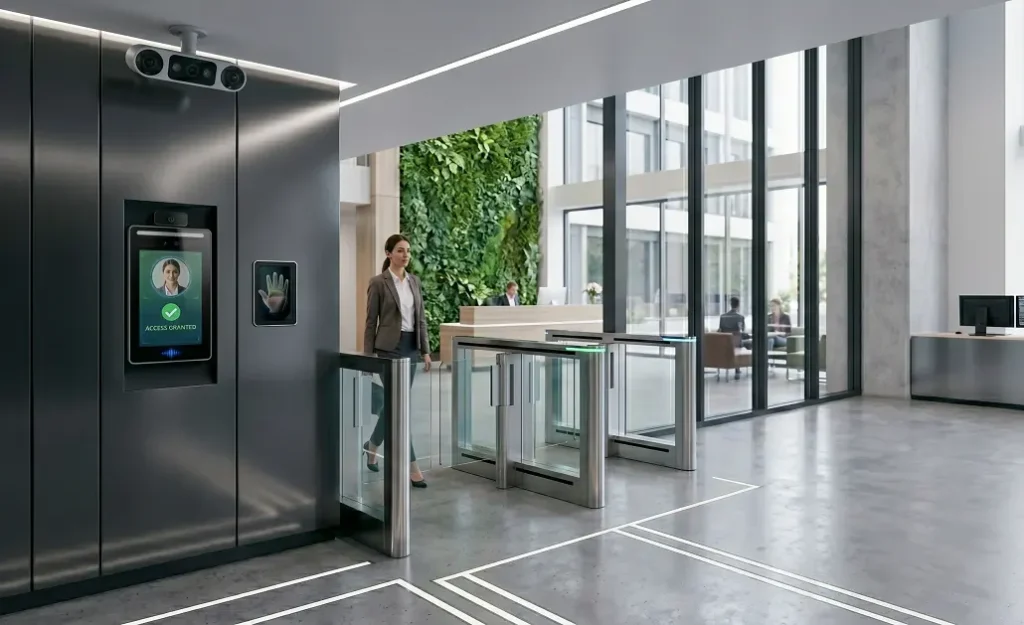
A key fob entry system uses a small wireless credential, usually carried on a keyring or ID badge, to unlock electrically controlled doors. The fob transmits a code to a reader mounted near the door. The reader passes that code to a controller, which checks it against an authorized list and releases the lock if the credential is valid.
Property managers, building owners, and facilities teams in offices, apartment buildings, warehouses, and mixed-use properties use fob systems to replace metal keys with credentials that can be added, restricted, or shut off instantly, without changing a lock.
This guide covers how these systems work, what separates a durable installation from one that fails on the first cold night, how key fobs compare to key cards and mobile credentials, and what actually drives installation cost. It draws on our team's work installing and retrofitting access control across Chicago-area properties, including pre-war masonry buildings where wiring and weather create constraints that generic buying guides tend to skip.
How a Key Fob Door Entry System Works
Every fob-based access point relies on four components working together:
- Credential (the fob): A small transmitter, typically RFID or Bluetooth-based, that stores a unique identification code.
- Reader: Mounted at the door, it detects the fob when held nearby and passes the code to the controller.
- Controller and management software: The controller checks the code against a permissions list and decides whether to unlock. The software is where administrators add users, set schedules, and pull access logs.
- Locking hardware: An electric strike, magnetic lock, or motorized lockset that physically releases the door on the controller's signal.
At the door, the sequence is simple: the user holds the fob near the reader, the reader reads the credential and forwards it to the controller, and the controller either releases the lock or denies entry and logs the attempt. Most commercial fob systems complete this exchange in under a second.
Fobs use RFID (radio frequency identification) rather than the magnetic stripe or swipe technology found on older key cards, which means there is no contact and no moving parts on the credential itself.
Types of Key Fobs and the Technology Behind Them
Not all fobs are built the same, and the credential technology a building uses has a direct effect on both convenience and security.
Security gap to know about: standard 125 kHz proximity fobs, still common on older buildings and used by many discount access-control kits, do not encrypt the ID number they transmit. Any reader within range can capture that number, and automated key-duplication kiosks found at hardware stores and some grocery chains can copy a standard prox fob for around $25, dispensed on the spot. This is a real perimeter security gap, not a theoretical one, and it is the single most common reason we recommend upgrading legacy fob systems during a building renovation rather than simply reprogramming the existing readers.
Encrypted 13.56 MHz credentials close this gap because the fob and reader perform a cryptographic handshake instead of exchanging a fixed code. A cloned or intercepted signal cannot be replayed to open the door.
Key Fob vs. Key Card vs. Mobile Credential
Fobs, cards, and mobile credentials all authenticate against the same reader and controller hardware. The difference is the form factor the user carries and how each holds up in daily use.
There is no universally superior option. A building with high staff turnover benefits from the fast reissue of mobile credentials. A property that also uses the credential as a visible ID badge, such as a medical office, gets more value from a printed key card. Many commercial buildings run a hybrid system, issuing fobs by default and adding mobile or card credentials for specific tenants or departments.
Key Card Entry Systems: What They Add
A key card is the same credential concept as a fob, just in a flat plastic form instead of a keyring tag, and it runs on the same reader and controller. Buildings choose cards over fobs mainly when the credential also needs to work as a visible ID, such as in healthcare facilities, schools, or hotels where front-desk staff confirm identity at a glance.
Most commercial cards use the same RFID technology as fobs, so the encrypted-vs-legacy distinction above applies equally: a 13.56 MHz smart card resists cloning the same way an encrypted fob does, while a 125 kHz proximity card carries the same duplication risk. Older magnetic-stripe cards are the exception. They require physical swiping, wear out faster from that contact, and can be rewritten, which is why they're being phased out of most new commercial installations in favor of contactless cards and fobs.
Types of Readers and Door Hardware
The reader and lock hardware matter as much as the credential itself, and this is where many buying guides stop short.
- Standard proximity readers authenticate a single credential type and are the most common installation for offices and apartment common doors.
- Keypad-plus-credential readers require both a fob or card tap and a PIN, used for higher-security areas such as server rooms, pharmacy storage, or building mechanical rooms.
- Video readers capture footage of every access event at the door, useful for entrances where a visual log matters alongside the credential log.
- Multi-technology readers accept fobs, cards, and mobile credentials at the same door, which lets a building phase in a credential upgrade without replacing readers building-wide.
Fail-safe vs. fail-secure locking hardware: this distinction is a code requirement, not a preference. A fail-secure lock, such as most electric strikes, stays mechanically locked from the outside during a power outage but still allows immediate interior egress. A fail-safe lock, such as a magnetic lock (maglock), unlocks automatically when power drops. Chicago Building Code Title 14B, Chapter 10 (Means of Egress) requires uninhibited egress through every exit door: occupants must be able to leave through a single motion, such as pushing a crash bar or an interior lever, without a key or electrical power. Chicago's electro-magnetic lock installation rules add specific requirements on top of that: a mag-lock must unlock immediately on loss of normal power and cannot rely on battery backup, the egress side of the door needs a UL-listed motion detector, lock, or panic device, and a clearly marked “Push to Exit” button must cut power to the mag-lock for at least 30 seconds. Getting this wrong on a life-safety exit is both a code violation and a real fire-egress risk, which is why we specify hardware type door by door rather than defaulting to one lock style for an entire building.
Benefits of a Key Fob System for Commercial Buildings

- No rekeying after turnover: When an employee leaves or a tenant moves out, an administrator deactivates the fob in software. No locksmith visit, no new keys cut, no risk that a former occupant still has a working key.
- Time-stamped access logs: Every credential read is logged with a timestamp, which supports incident investigations and helps property managers confirm who entered a building and when, without relying on a sign-in sheet.
- Scheduled and zone-based access: Fobs can be restricted to specific doors, floors, or time windows. A cleaning crew's credential can be set to work only after business hours; a tenant's credential can be limited to their own floor and shared amenity spaces.
- Faster turnover between move-ins and move-outs: For multifamily buildings, credential reissue takes minutes instead of the hours needed to rekey multiple units and common doors during a heavy leasing season.
Limitations and Security Risks to Plan For
A fob system is not maintenance-free, and an honest guide should say so.
- Legacy credential cloning: As covered above, standard 125 kHz fobs and prox cards transmit an unencrypted ID and can be duplicated cheaply. When a clone is used, the access log records the original credential holder's name, with no indication that a duplicate exists. Upgrading to encrypted 13.56 MHz credentials closes this gap.
- Replacement fee friction: Because reissuing a fob is an administrative process, not just a hardware cost, many management companies charge $50 to $150 per replacement even though a standard fob costs under $3 wholesale. Building owners should set this policy deliberately rather than defaulting to whatever a vendor proposes.
- Vendor and credential lock-in: Some access-control platforms use proprietary credential formats that only work with that vendor's readers. This forces a building into a single supplier for every future credential and repair. Open-standard credentials, such as MIFARE DESFire, avoid this by working across compatible hardware from multiple manufacturers.
- Network and power dependency: Cloud-managed systems need reliable internet and power at the controller. A building should confirm whether readers fail secure or fail safe during an outage, and whether the controller has local battery backup so the system keeps functioning without a live internet connection.
Cold-Weather and Retrofit Realities for Chicago-Area Buildings
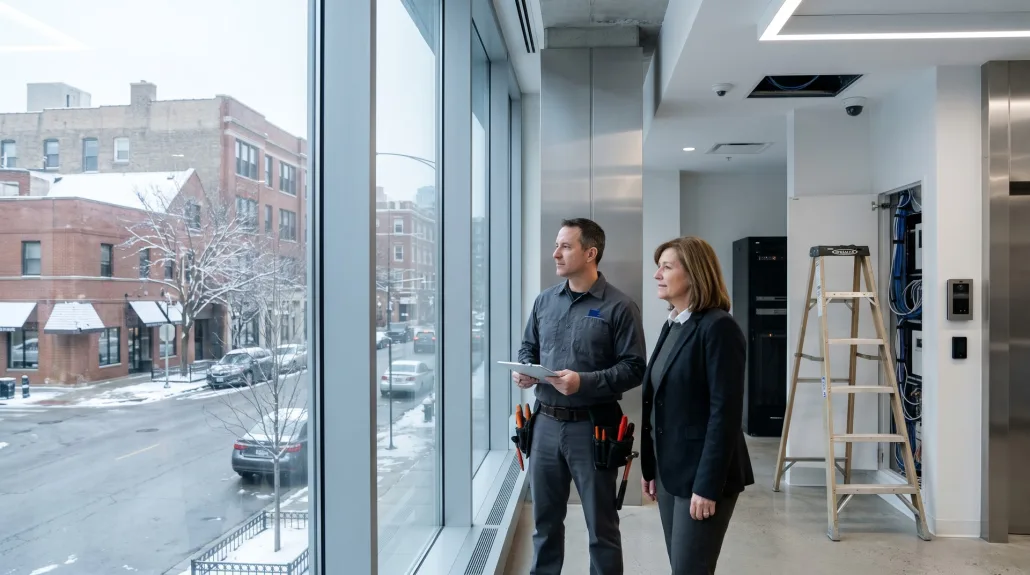
Chicago's climate and building stock introduce failure modes that most national buying guides never mention, and they matter for anyone evaluating a system for a Chicagoland property.
Sub-Zero Temperatures Stress Hardware in Three Ways
- Battery voltage collapse: Battery-powered locksets lose voltage under load in extreme cold. When the motor tries to draw enough current to retract the deadbolt, a chilled battery can't keep up, and the lock stops responding to any credential.
- Touchscreen and sensor failure: Exterior capacitive touchscreens and some readers lose sensitivity, or stop registering input entirely, once frost forms on the panel.
- Frame and strike binding: Door frames and door leaves contract at different rates during a rapid temperature drop, which applies lateral pressure, or pre-load, against an electric strike keeper. Even strikes built specifically to handle this problem are typically rated for only about 15 pounds of pre-load, and a standard strike without that rating can bind under less, so a correctly authenticated credential still fails to open the door.
Older Masonry Buildings Complicate Wiring
A large share of Chicago's multifamily housing, including many two-flats, three-flats, and courtyard buildings across neighborhoods like Lakeview, Lincoln Park, and Logan Square, was built with solid multi-wythe brick and no interior wall cavity. Running low-voltage cable from a controller to the entry door typically requires core-drilling through masonry and surface-mounted conduit, a materially different and more labor-intensive job than pulling cable through open stud walls in new construction. An accurate quote depends on a site visit that accounts for the building's actual construction, not a generic per-door estimate.
Chicago's Tenant Protection Ordinance Raises the Stakes of a Failed Lock
Under the Chicago Residential Landlord and Tenant Ordinance (RLTO Section 5-12-160), a landlord cannot knowingly oust or dispossess a tenant from a unit by changing, adding, or removing a lock or latching device without authority of law, and violations carry both a municipal fine and civil damages of two months' rent or actual damages, whichever is greater. Tenant advocates and legal aid organizations in Chicago have pointed to this ordinance when a landlord's neglected or unmaintained electronic entry system leaves a resident locked out, arguing it can expose the property owner to the same liability as a deliberate lock change. That's a strong argument for hardwired systems with central battery backup over standalone battery-powered locksets on exterior doors, and for building in a mechanical key override that doesn't depend on electronics at all.
Fire Department Access Still Needs a Physical Fallback
Multifamily buildings must maintain an approved Knox Box or equivalent override connected to the primary door strike so the Chicago Fire Department can enter during an emergency, even on a fully electronic system.
None of this means electronic access control is a poor fit for Chicago buildings. It means the hardware selection and installation method have to account for climate and construction type, which is exactly the kind of assessment a competent installer should walk through before recommending equipment.
How Much Does a Key Fob Entry System Cost?
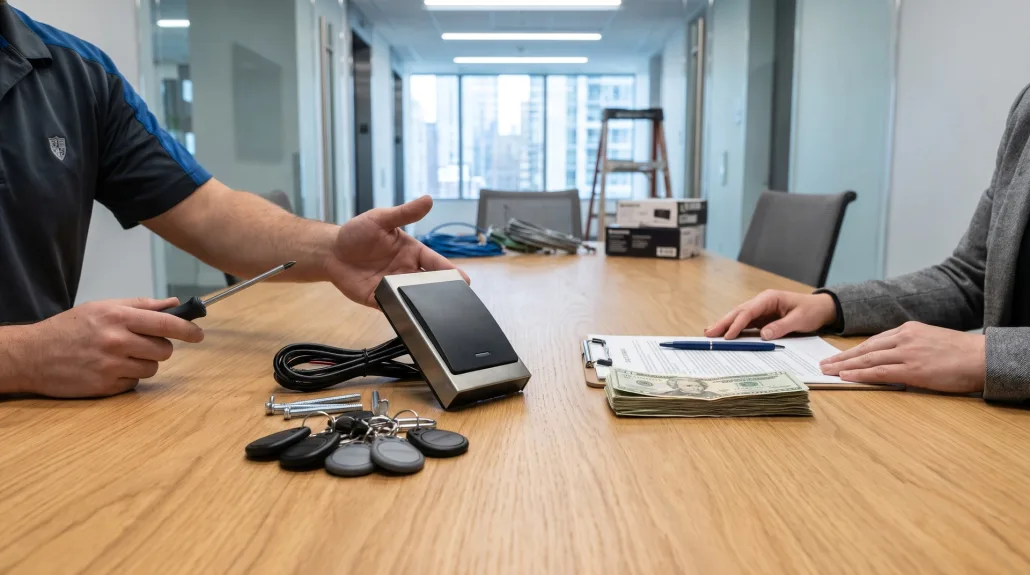
Installation cost depends on several factors that vary by building, and a single flat number rarely reflects what a specific property will actually pay:
- Number and type of doors: Each controlled entry point needs a reader, wiring or a wireless bridge, and compatible lock hardware.
- Existing wiring and construction: Buildings with accessible conduit or existing low-voltage runs cost less to retrofit than solid masonry construction requiring new core-drilled pathways.
- Credential technology tier: Legacy 125 kHz hardware costs less upfront than encrypted 13.56 MHz or mobile-credential systems, but carries the cloning risk described above.
- Software licensing model: Some platforms charge a one-time software cost; others charge a recurring per-door or per-user monthly fee that adds up significantly over a five- to ten-year hold period. This recurring cost is worth comparing as carefully as the upfront hardware price, especially for condo associations weighing the impact on reserve funds.
- Local battery backup and fail-safe/fail-secure hardware selection, which affect both material cost and code compliance.
Because of the number of variables involved, a site assessment is the only reliable way to get an accurate quote, and it is worth being cautious of any provider that offers a firm number before seeing the building.

Want an Accurate Number for Your Building Instead of a Range?
Request a free site assessment and our team will walk your property, account for door count, wiring, and construction type, and put together a quote based on what your building actually needs.
Keyless Alternatives Worth Knowing About
Fobs and cards are not the only way to go keyless. Three alternatives come up often during a system evaluation:
- Biometric readers authenticate a fingerprint, iris pattern, or other physical trait. They eliminate lost-credential issues but are generally not recommended for buildings prioritizing touchless entry, since most biometric readers still require contact.
- QR codes work well for temporary or one-time visitor access, such as a delivery or a guest, but are easy to forward or screenshot, so they should be time-limited and not used as a permanent staff credential.
- Mobile credentials use Bluetooth or NFC to transmit access data from a smartphone. Because a phone generates a new digital token for each unlock rather than broadcasting a fixed ID, mobile credentials avoid the cloning risk associated with legacy RFID, and lost-phone situations can be resolved by revoking the credential remotely rather than rekeying anything physical. The trade-off, as noted earlier, is battery dependency in cold weather.
How to Choose the Right System for Your Building
Before comparing brands or getting a quote, it helps to work through the building itself:
- Identify priority doors first: Not every entry point needs the same credential technology. Main entrances and amenity spaces are usually the priority; interior office doors can often be phased in later.
- Confirm existing infrastructure: Note what wiring, conduit, or prior access-control equipment is already in place, since this materially affects installation cost and timeline.
- Decide who needs to approve the credential type: Fire marshal sign-off applies to any change involving egress hardware or maglocks; a condo board or ownership group typically needs to review the software licensing model before committing to a recurring cost.
- Match the credential to how people already carry things: Staff who already carry an ID badge may prefer a fob or card combined with it; tenants who rarely misplace their phones may be well suited to mobile credentials.
- Plan for expansion: A system that can add doors and credential types later avoids replacing the entire platform when a building adds tenants or renovates.
This is the same assessment our team runs before recommending hardware, since a building's construction and use pattern usually matter more than the specific brand of reader installed.
Key Fob Entry Systems: Final Thoughts
A key fob entry system replaces metal keys with a credential that can be added, restricted, or revoked without changing a lock, and it remains one of the most reliable ways to manage access in commercial and multifamily buildings. The technology behind the fob, the reader and lock hardware selected, and the way a system is installed in a building's actual construction all affect whether it performs reliably for years or becomes a recurring maintenance problem.
Forbel Alarms designs and installs electronic access control systems for commercial and multifamily properties across Chicago and the Midwest, including apartment buildings with older wiring and masonry construction that require a different installation approach than new construction. If you're weighing fob, card, or mobile credentials for a specific building, request a free site assessment and our team will recommend hardware suited to your property, your budget, and Chicago's climate, instead of a one-size-fits-all package.

Heading
Common Questions Before You Choose a System
Will a key fob system still work if the power goes out?
It depends on the hardware. A controller with local battery backup keeps working through a short outage. Fail-secure locks stay locked but still allow interior egress; fail-safe locks unlock automatically unless they're wired with backup power. This matters in Chicago specifically, since a lock failure that traps a resident outside can be treated as a lockout under city ordinance, covered in detail in this guide.
Can a key fob be cloned, and does that make fobs less secure than key cards?
Cloning risk comes from the credential technology, not the shape. Older 125 kHz fobs and cards both broadcast an unencrypted ID that can be copied cheaply. Encrypted 13.56 MHz fobs and cards both resist this through a cryptographic handshake. A fob is not inherently more or less secure than a card of the same technology tier.
My building already has a proprietary access control platform. Can I switch without ripping everything out?
Sometimes. Multi-technology readers can accept new credential types alongside an existing system, which lets a building phase in a change instead of replacing every reader and controller at once. A site assessment is the only way to confirm compatibility with a specific existing platform.
What's a fair cost to replace a lost or stolen fob?
Reissuing a fob is mostly an administrative task, but many management companies still charge $50 to $150 per replacement for a fob that costs the property under $3 wholesale. That's a policy decision a building can set deliberately rather than defaulting to whatever a vendor proposes.
Do key fob systems fail in cold weather the way battery-powered smart locks do?
Standard hardwired fob systems with central battery backup hold up well in Chicago winters. The failures reported around the city mostly involve standalone battery-powered locksets and exterior touchscreens, not hardwired fob and reader systems. The cold-weather section above explains the specific failure points and what to check for before installing.